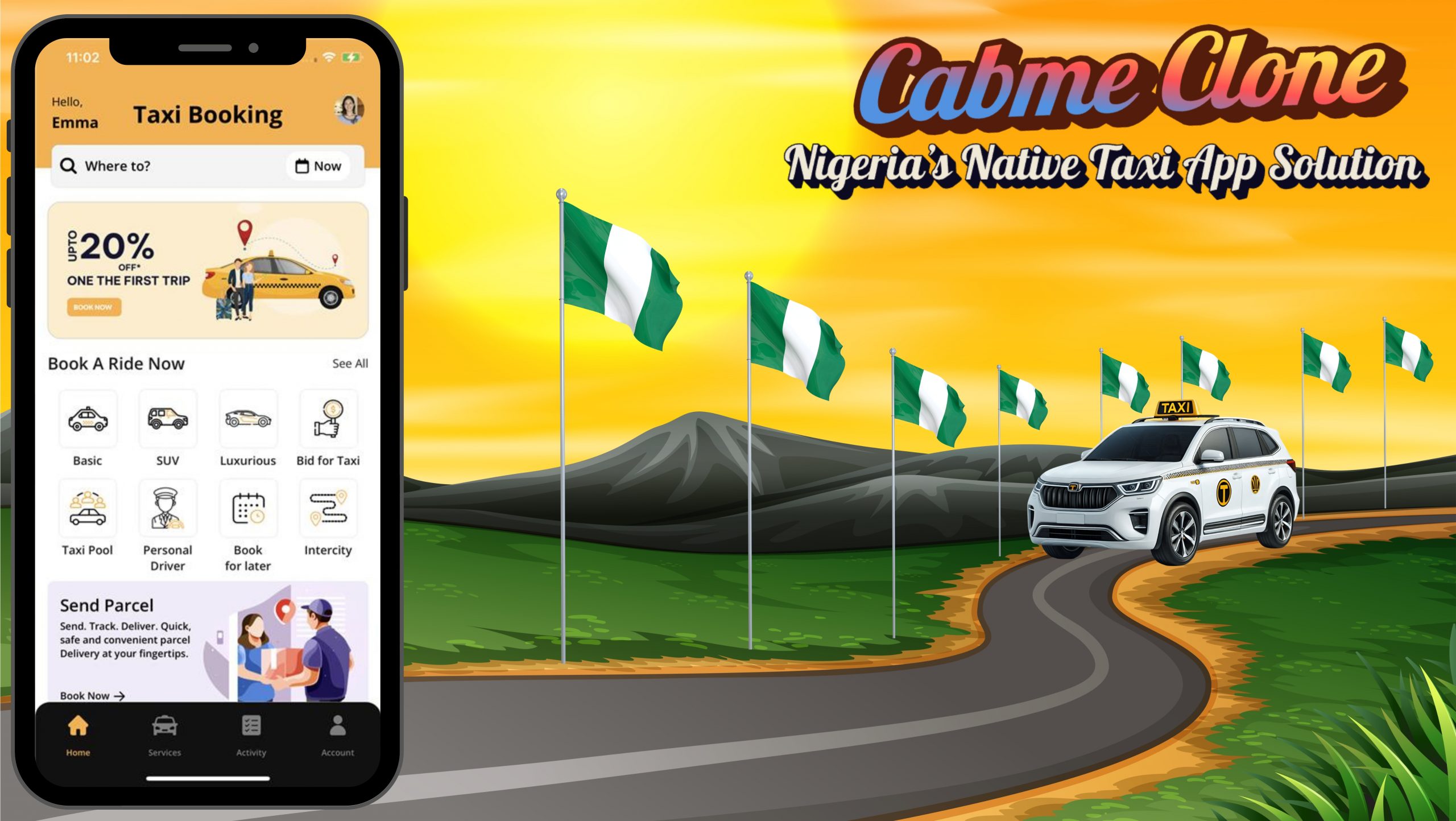
Cabme Clone is a ready-made taxi app solution that helps entrepreneurs start a local ride-hailing business quickly. If you are in Nigeria and thinking about launching a Taxi App Nigeria, clarity matters: what to build, which features to include, and which technology gives you the most reliable outcome.
This guide explains the whole story simply. You will learn what Cabme Clone offers, why there is confusion between native and Flutter tech stacks, how the two stacks differ, and why a native tech stack is usually the smarter choice for a taxi app in Nigeria. By the end you will know what to test in a demo and how to make the right choice for your market.
What is Cabme Clone?
Cabme Clone is a ready-to-run package for a taxi business. It usually includes:
- Passenger app for Android and iOS
- Driver app for Android and iOS
- Admin panel to manage drivers, fares, and reports
- Dispatch system, GPS tracking, and payment integrations
- Reporting, earnings dashboard, and support tools
A Cabme Clone saves you months of development. You focus on drivers, partnerships, and marketing while the core tech is already built.
From an entrepreneur’s perspective: this is a proven model. Taxi apps worldwide share the same building blocks. Cabme Clone packages those blocks into a launch-ready product so entrepreneurs in Lagos, Abuja, or Port Harcourt can go live faster.
Clarity before launch: what your users need
Before choosing technology, be clear about the user needs in Nigeria:
- Fast booking on low-speed networks
- Offline fallback and good retry logic for network drops
- Local payment methods (cards, bank transfer, USSD where needed)
- Driver onboarding, KYC, and earnings transparency
- Safety features: SOS, trip sharing, driver verification
- Local language support and simple UX
If your Cabme Clone delivers these well, you will get more repeat users and happier drivers. Technology must support these realities, that’s why the choice of stack matters.
Native Tech Stack Vs Flutter Tech Stack: the confusion
There is a lot of talk about Flutter because it promises single-code maintenance and faster initial build. Native development means building two apps: one with Swift/Objective-C for iOS and one with Kotlin/Java for Android.
Both choices are valid, but they solve different problems. Let’s compare them simply.
Flutter (cross-platform)
- One codebase for Android and iOS
- Faster to prototype and cheaper at the start
- Uses the same UI on both platforms
- Good for marketing apps, content apps, and simple workflows
Native (two codebases)
- Separate apps written in platform language
- Best performance, smoother animations, accurate UX
- Easier access to device-specific APIs (telephony, advanced GPS features)
- Better long-term stability for heavy realtime apps
This is the root of confusion: Flutter looks cheaper at first, but native often wins when your app must be fast, safe, and reliable under heavy real-world use.
Why native tech stack wins for Cabme Clone
For a Taxi App Nigeria, native development brings strong advantages that matter daily:
- Performance and responsiveness
Taxi apps are real-time apps. They require instant GPS updates, smooth map animations, and quick push notifications. Native apps handle these tasks with lower latency and fewer frame drops, so the driver sees directions and the rider sees accurate ETAs. - Better GPS precision and background services
Native stacks integrate deeply with device location services, background modes, and power optimization. This matters when drivers use the app for long shifts and the app must track location reliably even when the phone sleeps. - Lower defect density in production
Mature native tooling and platform APIs reduce unknown edge cases. For taxi services, fewer bugs mean fewer cancelled rides, fewer angry users, and less financial loss. - Advanced native features
Integrations like direct carrier billing, background audio for navigation, in-call detection, and advanced maps SDK features are easier and more stable in native code. - Smoother payment and local integrations
Some Nigerian banks or PSPs provide native SDKs that work best with platform code. Native apps often face fewer compatibility problems with local payment methods. - Scalability and maintainability for high load
When your fleet grows to hundreds or thousands of drivers, native apps platform maintain stability under heavy real-world use. This lowers long-term maintenance cost despite higher initial investment.
From an EEAT viewpoint, these points are based on experience and best practice: mission-critical apps that deal with money, safety, and real-time data benefit from the reliability that a native tech stack provides.
When Flutter still makes sense
Flutter is not bad. It fits certain situations:
- You need a fast proof of concept to test market demand
- Your budget is very tight and you can accept platform compromises at first
- The app will be lightweight, content-focused, or internal only
If you plan a rapid pilot across a small city, Flutter can work as an MVP. But plan the migration path: when volume and complexity grow, you will likely need native performance.
How to pick the right path for your Cabme Clone
Follow simple steps to decide:
- Define your user load and features: heavy real-time? Choose native. Lightweight MVP? Flutter can work.
- Check local integrations: do banks and map services provide native SDKs? If yes, prefer native.
- Ask about defect metrics and test cases the vendor runs. Demand evidence.
- Ensure the white-label supplier offers licensed source code and a migration plan if you start cross-platform.
- Always require demo apps for real phones in Nigeria. Test on common low-end devices and slow networks.
This process reduces risk and matches technology to market needs.
Launch process for your Cabme Clone
A simple four-phase plan gets you live:
Phase 1 – Discovery
Business goals, city zones, pricing model, and local payments.
Phase 2 – Native Android + Admin Panel
Branding, driver onboarding flow, Android app, admin setup, and maps config.
Phase 3 – Native iOS + Testing
iOS build, cross-device testing, and alpha pilots with a small driver group.
Phase 4 – Launch & Support
App stores, driver recruitment, customer support, and continuous monitoring.
This native-first route may take longer than a single Flutter build, but it cuts downtime and scaling surprises later.
Conclusion: pick stability, pick trust
If your goal is a long-term, reliable Taxi App Nigeria, the native tech stack for a Cabme Clone is the safer choice. It gives better performance, stronger GPS behavior, smoother payments, fewer defects, and more control when you scale.
Choice matters, but so does execution. Test demo apps, validate on local devices, check for source code ownership, and confirm the partner provides ongoing support.
Ready to see how a production-grade Cabme Clone with native apps works? Try the demo now, test on real Nigerian devices, and watch how native performance helps drivers and riders trust your service.
FREQUENTLY ASKED QUESTIONS
1. What is Cabme Clone?
Cabme Clone is a ready taxi app package that includes passenger and driver apps, an admin panel, and dispatch and payment features.
2. Why choose a native tech stack for a taxi app in Nigeria?
Native apps give better performance, more reliable GPS tracking, easier local payments, and lower defect rates — all crucial for ride-hailing.
3. Can I start with Flutter and switch to native later?
Yes, you can start with Flutter for an MVP but plan a migration strategy. Migrating later takes effort and costs, especially for real-time features.
4. How do I test a Cabme Clone before buying?
Ask the vendor for live demo apps, test them on low-end Android phones and iPhones, and simulate slow networks to see real behavior.
5. What should I check in a white-label provider?
Request live demos, confirm source code licensing, verify support SLAs, ask for references, and review their experience with taxi apps.