In today’s fast growing digital economy, app clone businesses have become the fastest and the most efficient way for entrepreneurs and startups to enter into the mobile app market. By cloning and replicating the models of already successful platforms like Uber and Zomato, businesses can significantly reduce the risk of app failure, save time and reduce cost which would be otherwise spent on developing a new app from scratch.
However, simply replicating and copying the model is not sufficient. In order for the app to be successful in the market and be valid for a long period of time, successful revenue model is also required.
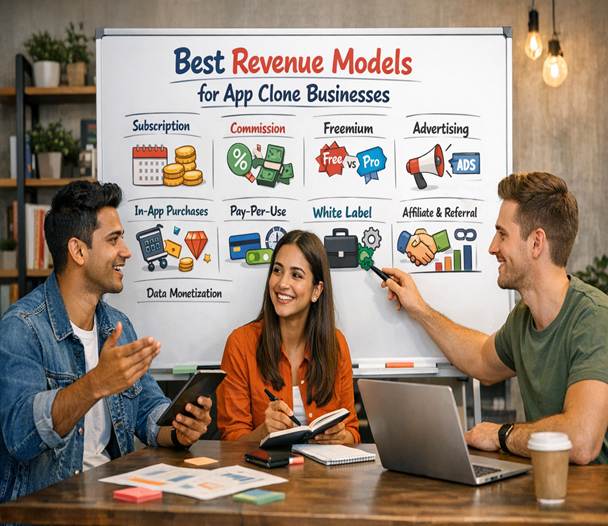
Revenue models decide how an app generates income- whether through subscriptions, commission, advertisements or other monetization strategies. A well-planned revenue model not only ensure steady work flow but also enhances user experience in the long run.
In this article, few of these famous revenue models are discussed which you can use for you app clone business.
COMMISSION BASED MODEL
One of the most widely adopted revenue model, specially in the ride sharing industry, is the commission-based revenue model. In this model, the platform charges a fixed commission for every ride booked through the app. Instead of charging users upfront, the business generates revenue only when users successfully complete a service or purchase.
This model is widely accepted by platforms such as Amazon, which charges seller a percentage of their sales or Airbnb, which earns commissions from both hosts and guests for booking made through its platform.
For startups, this approach is particularly attractive because there is no need of massive upfront investment or a complex business structure. As long as bookings are made, products are sold or rides are booked, money flows in, making it easier for new businesses to enter competitive market without any major financial risk.
However, the success of this model is only obtained through high user engagement and transactions. Businesses must ensure to charge a fair compensation rate to stay relevant and in the competition. Overall, this model is scalable and highly suitable for app clone business ideas.
IN APP ADVERTISEMENTS
The in-app advertisements revenue models helps in app clone businesses in generating revenue by displaying advertisements to the user within the application. Instead of charging the customers directly, the app generates revenue by receiving payment from the company whose adds they are displaying on their platform.
Instead of relying on commissions and subscription to generate revenue, startups can generate revenue and monetize their websites by providing place to local businesses, brands, or service providers on the platform. These advertisements can appear in various formats such as banner ads, video apps or pop-ups, depending on the app design and user experience.
One of the key advantages of in-app advertisements is that it allows the users to access the app for free, attracting a large user base. As the number of user increase, so does the potential of revenue generations. On the other hand, excessive or poor ad placement can hinder with the user experience, leading to app abandonment. Therefore, this revenue model should be used while maintaining a balance between monetization and usability.
IN APP PURCHASES
In-app purchase feature allows the user to buy some additional features, content or services within the app. While the app itself is free to download, users are encouraged to spend extra in return for better features and experience.
This model is popular among gaming apps like PUBG and clash of clans, where users pay extra to obtain features and skills like extra skin, weapons, game currency etc. and in dating apps like tinder and hinge where user spends money to buy unlimited likes.
The success of this model depends on providing the features and experience promised prior to the purchase. If the users feel that the features are expensive or over-priced, they are likely to cancel their purchase.
SUBSCRIPTION MODELS
The subscription revenue model is a widely used strategy in app clone businesses where user a pay a fixed, recurring fees go access the app features. Instead of a one-time payment, app focuses on recurring payment ensuring continuous revenue generation for the platform.
Popular platforms like Netflix and Spotify uses this model successfully by providing unlimited access to content for a fixed subscription fee paid every monthly, quarterly or half-yearly.
The major advantage of this model is the stable and secure revenue generation every month. It helps businesses plan for long term growth while building a loyal customer base. Users also benefit from continuous update, improved features and a better overall experience.
CONCLUSION
In conclusion, selecting the right revenue model is crucial for success and sustainable growth of app clone models. Weather it is commission-based earning (Uber), advertisement based (YouTube) or subscription based (Spotify), each model provides unique advantages based on the app’s purpose and advantages. A well-designed monetization strategy not only ensures consistent revenue but also enhances user experience and engagement. Ultimately, the key to long term success depends upon understanding user needs and maintaining value while continuously adapting the revenue approach.