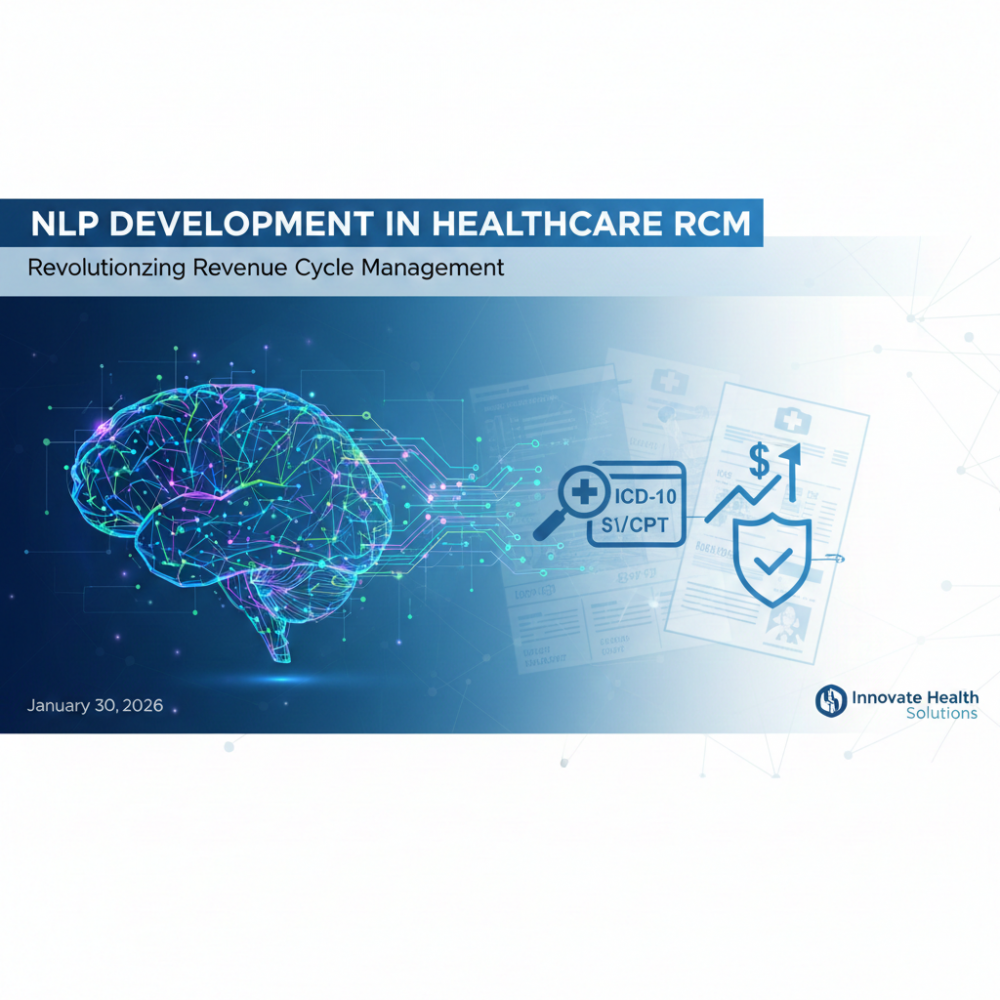
Anyone who’s worked inside healthcare revenue cycle long enough knows this: most revenue problems don’t come from technology failures. They come from misunderstandings. A physician documents one thing, a coder interprets it another way, and the payer reads it completely differently. Somewhere in that gap, money gets delayed or lost.
What sits at the center of that gap is language.
Clinical notes. Operative reports. Denial letters. Policy updates. Audit findings. Almost all of it is unstructured text written by different people with different goals. For years, RCM teams have tried to manage this with rules, templates, and manual review. That approach doesn’t scale anymore.
This is why NLP development companies are starting to matter in healthcare, not as hype, but as a practical necessity.
Why NLP suddenly feels unavoidable in RCM
Healthcare hasn’t lacked data. It lacks understanding.
Most RCM systems are great at handling structured fields: dates, codes, amounts. But the real signals live in free text. That’s where intent, justification, and compliance either exist or don’t.
Think about denial management alone. Payers rarely give clean, standardized reasons. They send paragraphs. Humans read them, interpret them differently, and try to act. NLP allows systems to consistently interpret those messages, find patterns, and surface what actually needs attention.
Same story with audits. Compliance issues are often visible months earlier in documentation but no one has time to read everything. NLP doesn’t get tired. It scans continuously.
This isn’t theoretical anymore. It’s operational.
What NLP actually does well in healthcare (when done right)
There’s a lot of marketing noise around AI, but in healthcare RCM, NLP tends to succeed in very grounded ways.
This helps coders catch documentation gaps before claims go out. It flags when a diagnosis is implied but not clearly supported. It highlights inconsistencies that would otherwise show up as denials weeks later.
For compliance teams, NLP quietly scans risk documentation. Not to accuse but to alert. That early signal is often the difference between a manageable correction and a painful audit.
And for leadership, it creates visibility. Not dashboards for the sake of dashboards, but real insight into where revenue is leaking and why.
None of this replaces people. It supports them when the volume is too high and the time is too limited.
NLP development companies making a difference in healthcare RCM
CaliberFocus
CaliberFocus approaches NLP from the reality of healthcare operations, not from a generic AI lens. Their solutions are built around actual RCM workflows, coding, billing, and compliance, not abstract language models.
What stands out is that their NLP isn’t positioned as a feature. It’s positioned as part of revenue protection. The models are trained on healthcare-specific language, which matters more than most buyers realize.
Among NLP development companies, CaliberFocus tends to appeal to organizations that want measurable outcomes rather than experimental tools.
Optum
Optum plays at scale. Their NLP capabilities are deeply tied to analytics, payer data, and enterprise-level healthcare operations.
They’re particularly strong when organizations need to understand trends across large volumes of claims, denials, and documentation. For big systems, that matters.
3M Health Information Systems
3M’s presence in healthcare documentation goes back decades. Their NLP capabilities are an extension of that history.
Hospitals already using 3M tools often lean on them for documentation improvement and compliance-related use cases. It’s familiar technology, and for many organizations, familiarity counts.
Nuance (Microsoft)
Nuance sits closer to the clinical side, but its impact on RCM is indirect and real. Better documentation leads to cleaner coding. Cleaner coding leads to fewer downstream issues.
For organizations already invested in Microsoft’s healthcare ecosystem, Nuance fits without much friction.
Clinithink
Clinithink focuses heavily on extracting meaning from complex clinical text. Their strength shows up in environments where documentation is dense and highly variable.
They’re often used where precision matters more than speed—analytics, compliance, and research-heavy workflows.
Choosing an NLP partner: the part vendors don’t emphasize
Here’s the truth: healthcare NLP fails most often when vendors underestimate how messy healthcare language really is.
Accuracy in general NLP doesn’t translate automatically to accuracy in RCM. Payer language is different. Clinical shorthand is different. Regulatory wording is different.
When evaluating NLP development companies, healthcare leaders should ask uncomfortable questions:
- How does your model handle ambiguous documentation?
- What happens when physicians document inconsistently?
- How do you validate outputs in regulated environments?
If the answers sound vague, that’s a red flag.
Where is this all heading
NLP in healthcare RCM isn’t about automation for its own sake. It’s about reducing preventable friction.
As reimbursement rules tighten and audits increase, organizations won’t have the luxury of manual interpretation at scale. Language understanding will become part of the core revenue infrastructure, quiet, embedded, and expected.
The organizations that adopt NLP thoughtfully won’t just move faster. They’ll make fewer avoidable mistakes.
Final thought
Healthcare revenue is rooted in language long before it appears in numbers.
Working with the right NLP development companies enables healthcare organizations to consistently interpret that language, protect revenue, and stay ahead of compliance risks without overburdening their teams.