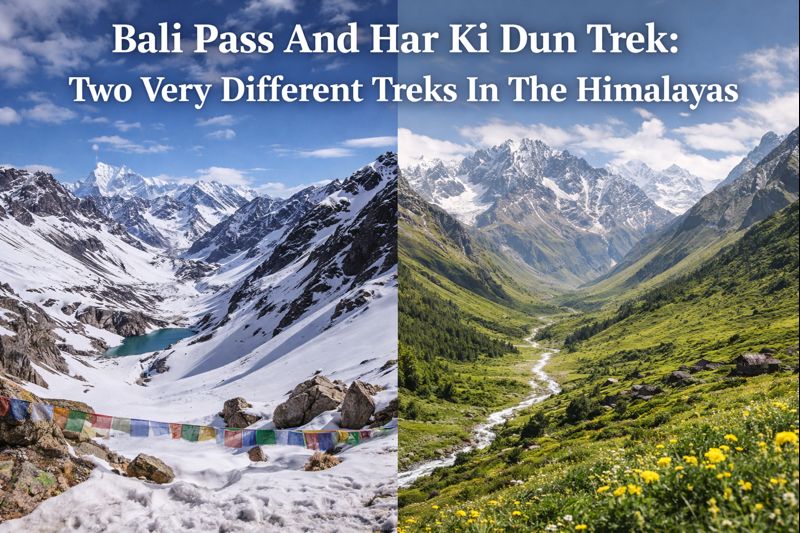
Uttarakhand is an area of tremendous diversity, which means there is a huge variety of trekking experiences that take place in this part of northern India. The two treks located in Uttarakhand, which have gained recognition as two contrasting treks, Bali Pass and Har Ki Dun, each offer their own unique trekking experience. The Bali Pass allows for a greater challenge for experienced trekkers due to its high-altitude crossing, while the Har Ki Dun is ideal for those looking for a more cultural experience with a perfect blend of the diverse beauty of nature. Both treks highlight the trekking diversity available in the Garhwal Himalayas.
Bali Pass Trek – A Challenging High-Altitude Adventure
Bali Pass Trek is one of the most difficult treks in Uttarakhand; it reaches a maximum elevation of about 5,227 meters (16,240 feet) and links Har Ki Dun Valley and Yamanotri Sacred Valley, which is considered by many to be the highest pilgrimage site according to Hinduism or Hindu mythology. Bali Pass Trek is suitable only for experienced hikers who feel confident regarding tackling long days on foot and significant elevation changes (>1,500 m) over challenging terrain at high elevations.
The Bali Pass route begins deep within the Govind Pashu Vihar National Park and moves through a variety of geographical features, including remote mountain villages, expansive meadows, and glacial landscapes. The route grows progressively more difficult as hikers ascend; there are many snowfields along with rocks/scree that hikers must cross safely and exposed ridgelines that may have vertical drops. The climb to the summit is the toughest day of your hike, as it involves climbing a steep incline to reach the summit and then dropping sharply down from the summit to reach the other side of the pass.
The Bali Pass Trek is unique due to its beautiful and pure surroundings, as well as offering a unique opportunity to view key peaks of the Himalaya, including Swargarohini, Bandarpoonch, and Black Peak. Because Bali Pass does not experience a large volume of foot traffic like other trekking routes, it comes out as a great trek for individuals who enjoy being alone, as well as for those who want to experience some extreme adventure.
Individuals will need to be extremely fit, have a high level of experience with high-altitude trekking, and have a well-developed acclimatisation strategy before embarking upon this journey. The best time to attempt this trek is generally in May-June or the post-monsoon month of September because weather conditions during these times are relatively stable.
Har Ki Dun Trek – Valley of Gods and Living Culture
The Har Ki Dun Trek is famous for its beautiful and eye-catching valleys, making it one of the most well-known and beautiful trekking destinations in the state of Uttarakhand, India. The trek is located at a height of approximately 3,566 meters (11,700 ft) and is often referred to as the “Valley of Gods” because of its spiritual and natural beauty.
While trekking through Har Ki Dun is less difficult and rugged than trekking over the Bali Pass, the Har Ki Dun Trek is rated as moderate in difficulty level, making it a popular trekking destination for beginners, families, and trekkers who would like to experience trekking at a slower pace while taking in everything that the breathtaking Himalayas have to offer. Along the way, you will pass through several ancient villages such as Sankri, Taluka, and Osla (the last village of the trek), along with the magnificent terraced white & red rice fields, traditional wooden houses, and more than hundred-year-old temples, all showcasing the local way of life.
Beginning at the Supin River, the trek leads to a wide expansive ecosystem that is made up of a variety of ecosystems, including glaciers and meadows, along with majestic snow-covered mountains, including Swargarohini and Hata Peak, as well as the extensive and dense deciduous forest consisting primarily of pine, deodar, and rhododendron trees, which also adds to the visual appeal of the area (especially during spring/summer).
The Har Ki Dun Trek is also home to a diverse range of plant and animal species. Hupeala (Rhododendron shrubs) are generally abundant throughout this trek, and, with a lucky chance, trekkers can spot several different species of Dhartrka (Himalayan langurs), Tahr (Bharal), and other species of birds.
There are clearly defined trails in the valley that allow for easy access to and navigation of all areas of the Har Ki Dun Trek.
Trekkers get the best experience on Har Ki Dun Trek as a complete trek from April to June and again from September to November when the weather is agreeable, and the views are unobscured.
Conclusion
The Bali Pass Trek and the Har Ki Dun Trek show us how different and unique the Garhwal Himalayas are. The first tests your endurance and your ability to do technical work at extreme heights, while the second lets you walk through the beautiful ancient valleys and live the traditions of the Himalayas. As an adventure-seeking trekker or as someone who wants to connect with the Himalayan landscape and culture, both of these treks are a unique experience in this region and are a definition of trekking within the state of Uttarakhand.