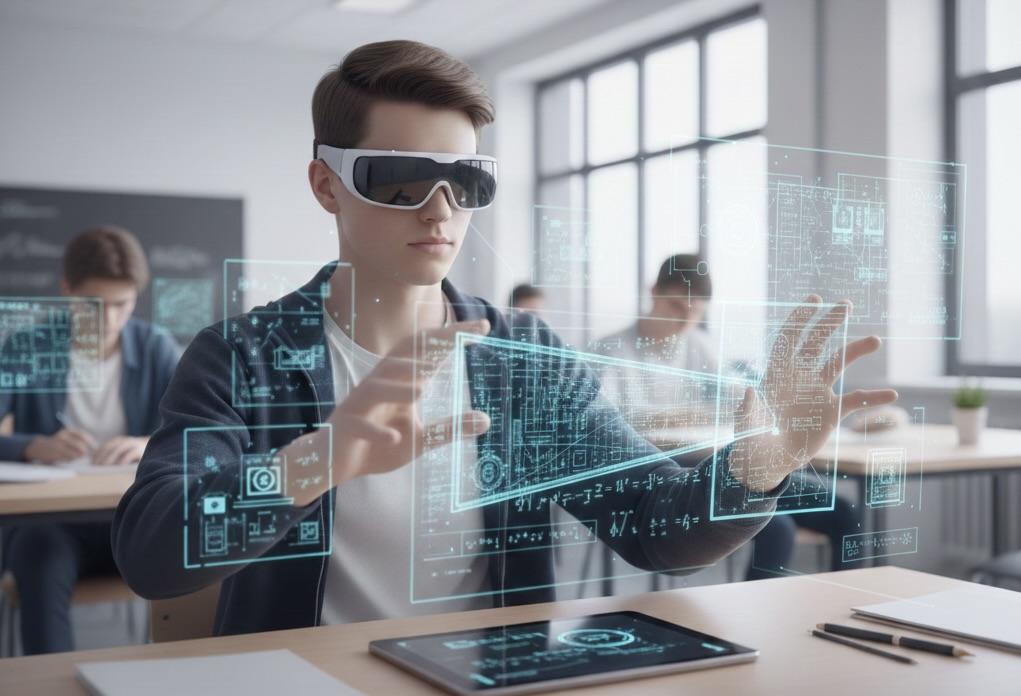
Augmented reality increasingly becomes a practical tool in modern education. What once appeared as experimental classroom demos now supports real learning goals across schools, universities, and professional training programs. As mobile devices and AR frameworks mature, educational institutions increasingly rely on experienced teams, such as an educational app development company, to design AR-enabled learning solutions that focus on comprehension, engagement, and long-term learning outcomes rather than visual novelty.
AR is a product of the transformation of education and how it is experienced by learners in accordance with their evolving needs as a society that are reliant on the availability of educational resources and technology. This product is the convergence of digital content and the physical world in a way that makes learning an interactive process instead of a passive one and meets the demands of learners for increased levels of engagement, personalization, and relevancy to their everyday life.
Why Augmented Reality Improves Learning Outcomes
Traditional learning methods are generally based on unchanging sources of information such as textbooks, diagrams, and slides. These types of information have been shown to be successful for many people, but their limitations become evident when trying to demonstrate spatial relationships, unseen interactions between two or more objects, or dynamic systems. The emergence of augmented reality (AR) as a tool for creating visual images of information allows learners to see information presented directly in their environment.
As students engage with three-dimensional (3D) objects, have access to real-time updating of data as they manipulate those objects, and view data from many different angles, the ability to understand that material increases exponentially. This approach enhances student success by accommodating all learners’ needs and reducing cognitive overload. More time can be spent interacting with the subject than trying to visualize what it is doing.
As such, AR-enhanced road maps generally report greater engagement and retention rates than traditional learning approaches, particularly in technical and scientific subject areas.
Practical Use Cases of AR in Education
Science and STEM Education
The advantages of augmented reality in STEM (science, technology, engineering, and mathematics) programs are significant because of the number of abstract or tiny concepts related to the subject matter. In biology, augmented reality allows students to view the layers of cells, tissues, and organs. While studying chemistry, students can see the interactions and reactions between atoms and molecules that are not visible to the naked eye. In physics, students can experience forces, motions, and energy transfer through real-life examples.
These types of experiences help to close the gap between theory and practice; rather than memorizing diagrams, students can actually work with models, conduct experiments, and see their results. Therefore, through these types of experiences, students can develop a better conceptual understanding of STEM programs and engage in more meaningful class conversations.
Vocational and Skills-Based Training
Augmented reality is a key tool in training and education for professionals. There are many industries that require hands-on training, however hands-on can be costly, dangerous or restricted based on equipment availability.
By using augmented reality based training, learners get to practice their procedures with a digital overlay on top of a real object or a simulated environment. Learners have access to step-by-step instructions, immediate feedback, and multiple attempts. This allows them to develop confidence in their ability to do the task and minimize mistakes before they move to the real world of work.
More companies in engineering, healthcare, manufacturing and logistics are starting to use augmented reality in their onboarding, certification and continuing education programs.
Language and Cultural Learning
Learners can enhance their language acquisition when they build connections between words and real-world contexts. Augmented reality allows learners to associate words with tangible items, places, and experiences. By using an electronic device to point at an object that they encounter daily (or some similar situation), learners can easily access a translation, audio pronunciation, or usage.
In addition, AR provides learners with opportunities to virtually explore a recreation of a cultural site, event, or environment. By providing these types of interactive experiences, AR allows learners to develop a greater understanding of the cultural context of material they are learning as well as the historical significance of that material, therefore making lessons more interesting and memorable for them.
Remote and Inclusive Education
Learners who cannot attend physical classrooms can benefit from augmented reality, providing access to education through an alternative means of instruction. Augmented reality technology also provides independent practice in a structured way through the use of virtual labs and augmented reality guided exercises. Augmented reality has great potential for providing inclusive education, as it supports the unique learning needs of each learner. By incorporating visual cues, interactive prompts and adjustable rates of speed, all learners, regardless of their abilities, can engage comfortably with the content. This flexibility means that augmented reality may provide a viable method for establishing a personalized and accessible learning environment for all learners.
Key Considerations When Implementing AR in Education
When creating AR solutions used for the purpose of learning, the first thing to do is determine a clear learning objective. The next step is for teams to identify what problem they want to solve with AR and how using AR will enhance the learning experience. Technology will support pedagogy, not serve as the driving force.
Next, technical limitations/scale will affect the implementation of AR. Many schools/institutions have a mid-range (typically lower-ability) smartphone/tablet fleet, so it’s critical that the AR application performs optimally and has an easy-to-use interface. Basic interactions, responsive behavior, and minimal hardware requirements are necessary for a large number of users.
Lastly, scalability is also important. As the content delivered within an educational setting is frequently changing, as new curricula are developed and new students added. Therefore, AR systems must permit for easy upgrading of modular content, easy maintenance, and easy integration with learning management systems, or they will not be sustainable for long-term use.
Common Challenges and Limitations
Although augmented reality has many advantages, there are obstacles that must be overcome in order for it to become widely utilized in educational settings. For example, developing augmented reality content requires a higher degree of expertise and capital investment than traditional forms of media. Additionally, the use of multiple devices to run an augmented reality application complicates the process of testing, optimizing and integrating animation into lesson plans.
By addressing these obstacles early on, an organisation has a greater chance of effectively implementing the technology. Developing effective onboarding procedures and conducting pilot testing will assist educational institutions in transitioning away from experimental phases of the use of AR to long-term implementation.
References and Trusted Sources
This article’s observations are consistent with research and publishing by many organizations, such as UNESCO, that focus on the use of digital education, as well as with studies conducted by IEEE regarding augmented reality as a medium for learning.
There are many sources that suggest that augmented reality offers a unique and valuable form of learning, particularly when it is developed and used in accordance with sound instructional design principles and with a clear intent for instruction.
Conclusion
The use of augmented reality within the education sector completely transforms how students learn by allowing them to become active learners rather than just watching passively from their seats. However, when used with intention, AR provides an experience for learners to help them understand difficult concepts, practice skills in a safe environment, and encourage continued engagement in their own learning process.
As digital education continues to evolve, AR is becoming an increasingly viable and scalable technology that will enhance traditional higher education as well as improve employee development and lifelong learning.