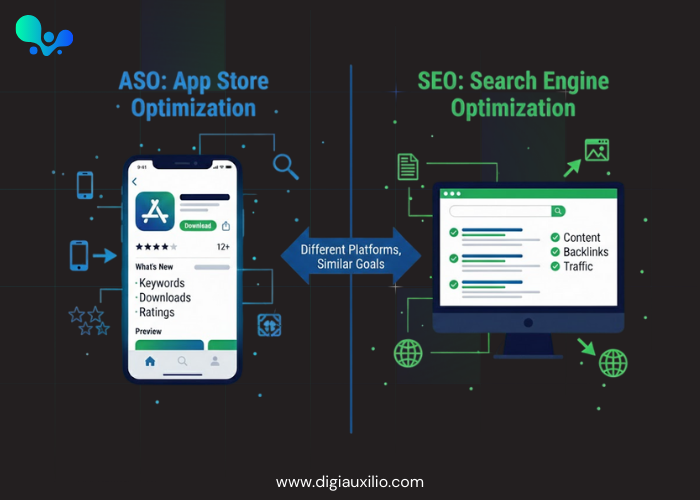
In today’s world, success in business requires a certain level of digital visibility, which could mean getting a website or building a mobile app. Knowing how to improve the performance of mobile app stores and search engine results will help businesses spend their marketing budget in a smarter way. Although App Store SEO and traditional SEO have basic principles in common, the way they are executed is different. Most digital marketing firms understand that, in a successful mobile strategy, both disciplines have to be mastered and that similar approaches cannot be taken.
Search engine optimization and app store optimization have a common goal and that is to improve visibility and get the best traffic for free. However, the tools, approaches, and even the optimization techniques are almost completely different. One of the major reasons businesses are frustrated with ASO services is the misconception that traditional SEO will work in an app store. This guide will help you understand the differences that come with the two forms of optimization, their importance, and how they complement each other.
Platform Differences: App Stores vs Search Engines
The fundamental distinction begins with where optimization occurs and what users seek.
SEO Targets Search Engines: In traditional SEO, the goal is to optimize a website so that it ranks higher in search engines like Google and Bing. People use search engines to try to get as much knowledge as possible on a certain topic or get a hold of a particular product or service. When people search for the types of products or services a business provides, a business’s success is determined by how high its website ranks in the results, as the users are likely to only focus on the first few results.
ASO Targets App Stores: App store optimization focuses exclusively on the Apple App Store and Google Play Store. Users specifically seek mobile applications to download and install. Visibility within these closed ecosystems determines whether apps get discovered or remain buried among millions of competitors.
Digital marketing companies and service providers must acquire proficiency in both platforms since methods that enhance Google rankings may not necessarily boost visibility on the App Store.
Keyword Strategy Differences
Both disciplines rely on keywords, but character limits and indexing mechanisms create distinct optimization approaches.
SEO Keyword Flexibility: There are no restrictions on the number of keywords or pages that a site can target. There is also scarcely any restriction on content length—well-optimized long articles of over 2,000 words do rank quite often. The words used for titles, headings, body content, meta descriptions, and URLs with the flexibility to determine where the best placement is.
ASO Character Constraints: App Store SEO works within STRICTER limits. The Apple App Store gives only 100 characters (not visible to the user), while Google Play indexes the whole 4,000-character description. It is critical to note that in ASO, if there is any wastage of characters by repeating words or using wrongly selected keywords, it will directly limit how much discoverability you can get.
ASO services specialize in maximizing these limited spaces through sophisticated keyword research identifying high-value terms and strategic placement that websites never face.
Visual Asset Importance
User decision-making processes differ dramatically between finding websites versus downloading apps.
SEO Visual Elements: Images, videos, and design shape how people feel about your website. Sure, they boost engagement—people stick around longer, click more, that sort of thing—but they don’t really move the needle when it comes to search rankings. Google cares way more about your content and your backlinks than how pretty your site looks.
ASO Visual Dominance: Now, in the app world, visuals matter a lot more. App icons, screenshots, and those little preview videos? They’re make-or-break. People scroll fast and decide in seconds if they’ll download your app, mostly based on what they see. You can stuff your listing with keywords all day, but if your visuals are dull or sloppy, conversions tank. On the flip side, apps that look sharp—even if their optimization is just okay—tend to win over users.
Digital marketing companies That’s why true ASO services bring designers onboard to craft visuals that actually drive downloads. Most old-school SEO agencies don’t even touch this stuff.
Backlink vs Rating Dynamics
Authority signals differ fundamentally between platforms.
SEO Backlink Foundation: Back to traditional SEO: backlinks still rule. If you want to climb the rankings, you need links from respected sites. Building a strong, diverse backlink profile takes real work—think content marketing, digital PR, and networking. But it pays off. Over time, those links give your site lasting authority.
ASO Rating Focus: For apps, though, it’s a different game. The app stores care way more about ratings and reviews than backlinks. Apps with 4.5 stars or better crush those sitting at 3.5, no matter what else is going on. And it’s not just about your average rating—fresh reviews matter. Apps with a steady stream of new ratings consistently outrank those with nothing but old feedback.
While backlinks don’t directly impact app rankings, app store optimization requires entirely different authority-building strategies focused on user satisfaction and review generation.
Update Frequency and Algorithm Changes
Both platforms evolve constantly, but at different paces and with varying transparency.
SEO Algorithm Updates: Google launches major algorithm changes several times annually, plus lots of smaller tweaks all the time. Sure, they share general advice, but the real ranking factors are still kind of a mystery. That means SEO is all about staying on your toes and adjusting as Google changes the rules for billions of sites.
ASO Algorithm Stability: App store algorithms change less frequently and dramatically than search engines. Apple and Google provide clearer guidelines about ranking factors for apps. However, app store optimization still requires monitoring changes and adapting strategies accordingly.
Digital marketing companies’ people who focus on both areas don’t just guess or use a one-size-fits-all approach. They keep separate knowledge bases and watch each platform closely because each one changes in its own way.
Conversion Optimization Differences
The end goal differs between driving website traffic and generating app downloads.
SEO Conversion Paths: Websites convert visitors through various paths—form submissions, purchases, phone calls and email signups. Conversion optimization happens on-site through landing page design, copywriting, and user experience improvements.
ASO Conversion Focus: App Store SEO websites turn visitors into customers in all sorts of ways—maybe someone fills out a form, buys something, calls, or signs up for emails. If you want better conversions, you work on the site itself. That means you tweak landing pages, write sharper copy, and keep making the whole experience easier and more appealing for users.
Quality ASO services A/B test visual assets and descriptions systematically, optimizing conversion rates from impressions to installs—a distinct discipline from website conversion optimization.
Geographic and Localization Strategies
Both benefit from localization, but implementation differs significantly.
SEO Localization: Websites can create unlimited localized versions with translated content, region-specific domains or subdirectories, and locally relevant content. Geographic targeting happens through content, hosting location, and local citations.
ASO Localization Complexity: App store optimization requires separate optimized listings for each target market—translated keywords, localized screenshots showing relevant languages and cultural elements, and region-specific descriptions. Apple App Store supports 40 languages; Google Play supports 77.
Managing localized app store optimization across multiple markets requires coordination exceeding typical SEO localization efforts.
Measurement and Analytics
Tracking success looks different across platforms.
SEO Metrics: Google Analytics and Search Console let you track how your website’s doing—things like rankings, organic traffic, click-through rates, bounce rates, time on site, and conversions. You get a pretty solid view of what’s working and what’s not.
ASO Metrics: On the app side, it’s a bit different. App Store Connect and Google Play Console show you impressions, conversion rates (from views to downloads), keyword rankings, ratings, reviews, and retention rates. These numbers might not match up with website metrics, but they’re just as important if you want to know how your app’s performing.
Digital marketing companies providing both services maintain separate analytics frameworks, recognizing that success metrics differ between disciplines.
When Businesses Need Both
Most businesses with mobile apps benefit from both SEO and ASO services working together.
SEO drives awareness: Website rankings help brands show up for people who aren’t even looking for an app yet. They put you on the radar.
ASO captures intent: But once someone’s in the app store, searching for a solution, you need your listing to do the heavy lifting. If it’s not optimized, you’re missing out on downloads—plain and simple.
Integrated Strategy: The most successful mobile businesses coordinate SEO and app store optimization, ensuring consistent messaging, leveraging website traffic for app promotion, and using app success stories in content marketing.
Knowing the difference between ASO and SEO is huge. They might sound similar, but they’re not the same game. Each one needs its own approach and skill set. Whether you handle things yourself or bring in a marketing agency, remember: ranking in app stores takes dedicated ASO work. Regular SEO just doesn’t cut it.
Frequently Asked Questions
Is ASO easier than SEO?
Not necessarily. ASO has fewer ranking factors but stricter character limits, requiring precision. Both demand specialized expertise—app store optimization isn’t simply “SEO for apps.”
Can the same company handle both ASO and SEO?
Quality digital marketing companies maintain teams with both specializations. However, verify specific ASO services experience rather than assuming SEO expertise transfers automatically.
Which delivers faster results?
ASO typically shows results faster (2-8 weeks) than SEO (3-6 months) due to less competition and simpler algorithms. However, both require ongoing optimization.
Do I need ASO if I have good SEO?
Yes. Strong website rankings don’t guarantee app store visibility. App Store SEO requires separate optimization since search engines and app stores operate independently.
How much do ASO services cost compared to SEO?
ASO usually costs between $1,000 and $5,000 to get started, then $500 to $2,000 each month after that. SEO’s a bigger commitment—sometimes $1,000, but it can shoot up past $10,000 per month if you’re in a tough market. Either way, you’re looking at a real investment.
Should startups prioritize ASO or SEO first?
If you’ve got a mobile app, focus on app store optimization first. It’s the fastest way to bring in users. Once that’s rolling, layer in SEO to keep your growth steady over time. A good digital marketing agency can help you figure out the right order for these steps.