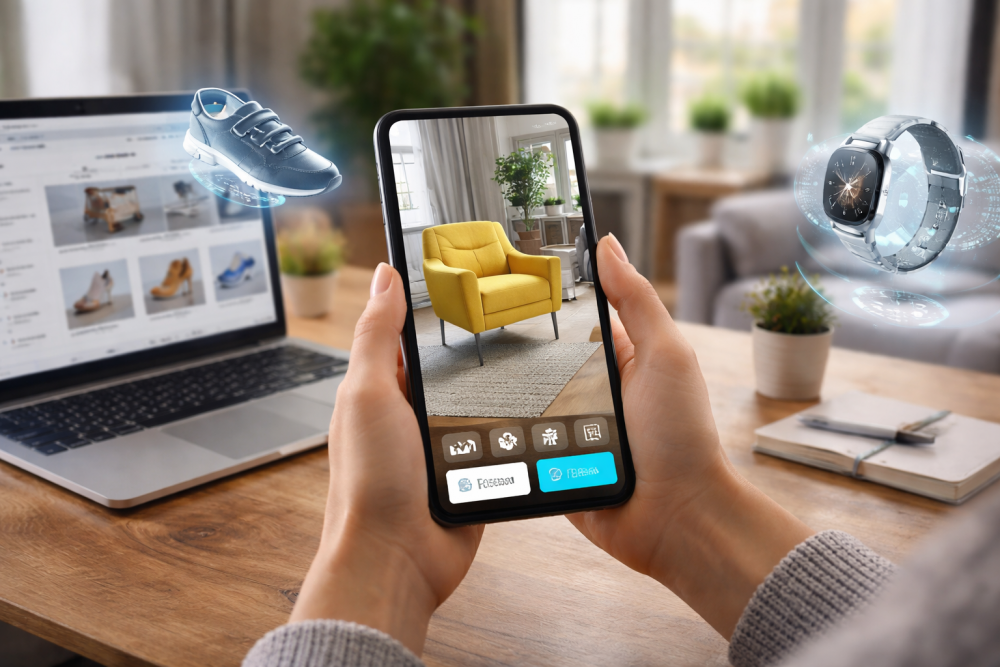
The ever increasing trend of shopping online has driven companies to look for innovative ways that can upgrade the user experience and eliminate the consumer’s doubt in digital purchases. A great technological breakthrough would be using augmented reality (AR) in the same way as e-commerce clone scripts. With AR technology, a physical and a digital store are two points that become a line, as customers are enabled to see the product in the real place of usage even before buying it.
Developers and companies that rely on e-commerce clone scripts can take AR integration as a viable option to upgrade features and attract users more efficiently, thus skipping the platform reconstruction stage.
Understanding AR in Modern E-Commerce Platforms
Augmented reality in online shopping is essentially about offering customers the chance to see and explore 3D models of products with the help of digital overlays. Customers thus are not limited to just looking at pictures and reading descriptions but are given the ability to virtually put a piece of furniture in their room, for instance, or to try on clothes with the help of AR features.
In the case of e-commerce clone scripts, the addition of AR features basically means the scripts get the capacity for immersive product visualization beyond their current framework. Such scripts, which provide the basic functions of well known e-commerce sites, can be made with AR modules to accommodate interactive shopping experiences.
How AR Enhances the Online Shopping Experience
AR features in online stores provide several functional benefits:
- Product visualization: Customers can see how furniture, clothing, or accessories look in real environments.
- Improved decision-making: Interactive previews reduce guesswork and increase confidence in product selection.
- Reduced return rates: Accurate visualization helps shoppers make informed purchases, minimizing mismatched expectations.
By embedding AR in e-commerce platforms, developers create a more intuitive and engaging interface that aligns with evolving consumer expectations.
Technical Approaches to AR Integration
Integration of augmented reality with e-commerce clone apps is a matter of combining both frontend and backend development strategies. The process practically means choosing AR frameworks that are compatible and guaranteeing that communication with the platform’s architecture is seamless.
Choosing AR Development Frameworks
Generally, developers use AR software development kits (SDKs) that enable cross-platform compatibility. Such frameworks make it possible for developers to come up with 3D product viewers and real-time object placement features. It is crucial to check if the AR toolkit is compatible with the clone scripts technology stack to ensure smooth performance and scalability when choosing it.
Implementing 3D Product Models
Having 3D product models that are optimized is probably one of the biggest components when it comes to augmented reality shopping. These models should be of such a size that they can be loaded quickly without sacrificing visual accuracy. If you do compression and file format properly, AR files will not be a problem in terms of page speed or mobile responsiveness.
API Integration and Data Synchronization
AR modules very frequently call for API connections to be able to fetch product data dynamically. Synchronizing product catalog, inventory data, and AR assets is the way to maintain the consistency that exists between the visual experience and backend operations. An efficient API integration enables real-time updating and the smoothest possible interaction between AR functionalities and regular e-commerce operations.
User Experience and Interface Design
Successful AR integration goes beyond technical implementation. The user interface must guide shoppers through AR interactions in a clear and accessible way.
Simplifying AR Access for Users
AR features should be made very easy to use during the shopping journey. Besides giving great user experience, clear prompts, intuitive icons, and minimal setup steps help the adoption of AR features. Mobile optimization is a very big deal here because a lot of augmented reality shopping experiences are dependent on smartphone cameras and sensors.
Performance Optimization
Maintaining fast loading times should be a priority when AR is integrated in e, commerce. Developers need to balance the visual quality and performance efficiency. Lazy loading, asset caching, and adaptive streaming are some of the methods that help provide smooth AR interactions while still maintaining the performance of the entire site.
Security and Compatibility Considerations
Adding AR capabilities introduces new technical considerations related to security and device compatibility.
Device and Browser Support
It shouldn’t be assumed that all devices are capable of running advanced AR features. Developers must also provide alternative options that would let users still be able to look at products even if AR features are not available. One good practice is to test a product’s performance by using different operating systems and browsers to be able to deliver consistent performance.
Data Privacy and Security
AR applications might need to open up the device camera and sensors. A clear indication of permission and secure data practices are a must for user privacy protection. Encryption and secure communication protocols can be considered as a first line of defense for sensitive information exchanged during AR experiences.
Challenges in Scaling AR Features
The integration of augmented reality into e-commerce clone scripts certainly brings remarkable benefits, however, the expansion of such features is where the real issues arise. Producing top, notch 3D models may use up a lot of resources, and the task of keeping the app running smoothly on different devices is a never ending job.
Besides that, bandwidth restrictions, storage, and changes in the AR frameworks all affect how the product will be maintained down the line. Developers have to come up with architectures that not only meet the current level but also can be easily upgraded in the future without interfering with the main functions of the online store.
Finding the right mix of deeply engaging AR experiences on one hand and, on the other hand, simplicity, speed, and ease of maintenance is the key concern of the teams that are working on the incorporation of AR in the new e-commerce platforms.
Final Thought
Embedding augmented reality in e-commerce clone scripts is just one example of the online shopping trend becoming more interactive and experiential. As AR tech gets better, it will influence even more the way shoppers see and buy stuff. To make AR really work and have a significant impact on the users, developers and retailers should focus on easy to use, high-performance, and secure implementations.