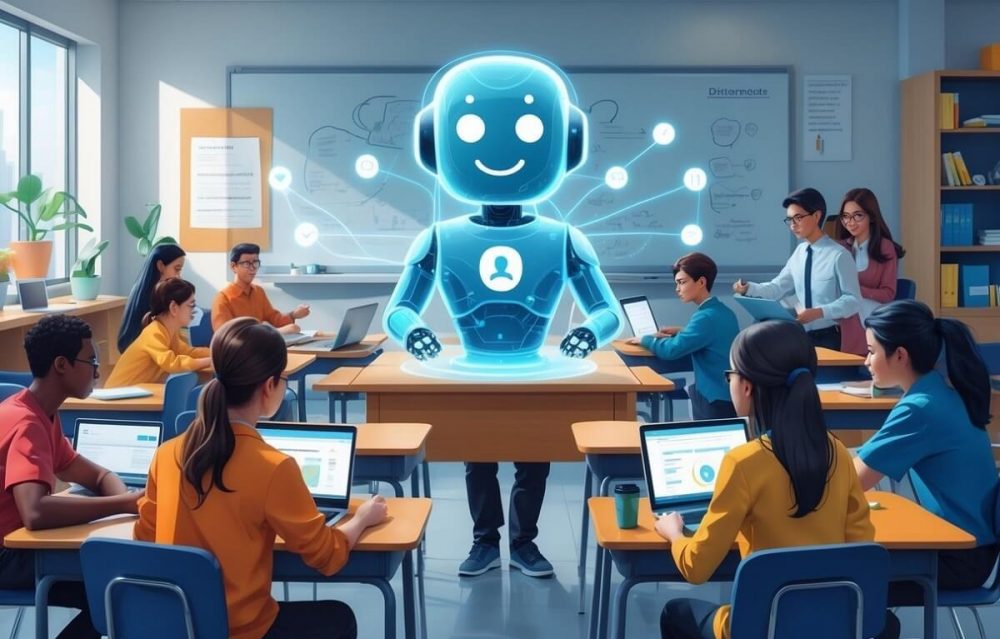
AI is no longer just a futuristic concept limited to science fiction movies. It has made its way quietly and powerfully into the classrooms all across the globe. All teachers and educators are excited about utilising AI in the classrooms, but they are unaware of what comes next.
Moreover, AI is reshaping how teachers in primary or higher education teach and how students learn. Also, some students fear that AI will take over humans, but in the education sector, its role is to enhance the teaching and learning experience. AI has emerged as a supportive partner assisting teachers in personalising learning, saving their time, and creating more engaging classrooms.
In today’s world, the question is not whether to use AI in education, but how teachers can use it effectively, ethically, and creatively. So if you want to know how teachers use AI in the classroom and how it enhances the learning outcomes, then this blog is for you. Let’s begin!
Understanding AI in Education
Before we dive deep into the application of AI in the classroom, we should know what AI in education actually means.
AI refers to large language models (LLMs)and computer systems that can analyse data, identify patterns, learn from experience, and make decisions or suggestions.
The application of AI in education includes assisting students in learning and improving the teaching process. Moreover, AI can help teachers tackle challenges such as:
- Guiding and teaching students with various needs.
- Providing an enriching multimedia experience.
- Providing personalised tutoring.
| “Out of 1,186 respondents, 60% of teachers stated that they had integrated AI into their teaching plans, while 39% stated otherwise.” source:(humaniseAI) |
Application of AI in the Classrooms
1. Personalised Learning; Greater Inclusivity
The major challenge teachers face is addressing diverse learning needs in a large classroom. We all know that students learn at different paces, have different abilities, and demand different levels of guidance. So, AI is beneficial in this regard.
How does AI Support Personalised Learning?
An AI-powered platform analyses student performance and customises their learning experience accordingly. For example, if a student faces challenges with algebra topics, AI can provide extra practice questions and simplified explanations. Moreover, a student who performs better may receive advanced problems.
Moreover, this kind of personalisation is difficult for a single teacher to achieve in a large classroom. AI helps teachers to focus on their teaching while it focuses on the customisation of the learning material.
In addition, the teacher’s role still matters. AI can provide recommendations, but the final decision maker in the classroom is the teacher. A teacher ensures the learning experience is meaningful and inclusive.
2. Smarter Lesson Planning
Lesson planning requires lots of time and effort. Teachers used to spend hours creating a lesson plan, worksheets, presentations, quizzes, and discussion prompts. However, AI has reduced this burden for teachers.
As a teaching assistant, AI can generate lesson plans aligned with the learning objectives, create quizzes, worksheets, and homework, adapt the material for different grades and learning abilities of students, and suggest engaging classroom activities.
Teachers don’t have to start from scratch; instead, they can just refine and customise AI-generated material. It saves their time and effort. As a result, they can focus on innovative teaching strategies, project-based learning, and engaging discussions in the classrooms.
3. AI Supports Students’ Engagement and Inclusion
Student engagement relies on effective teaching. Being a supportive teaching assistant, AI can make the classrooms more interactive, immersive, and relevant.
Moreover, AI-powered educational tools can turn lessons into gamified experiences, offer instant feedback during practice, and use virtual environments to explain complex concepts. Suppose, students want some help with their research paper publication. So, it will make it easier for the teacher to asses the quality, possible improvements and effective planning.
4. Automated Assessment and Instant Feedback
Grading is a time-consuming task. AI can help automate the assessments and provide quick feedback. Moreover, AI systems can suggest initial comments, and later, teachers can personalise this feedback.
AI systems are efficient in grading multiple-choice and short-answer questions, quizzes and formative assessments, and grammar-based assignments, etc.
As a result, teachers can focus on other classroom activities and student engagement.
Also, quick feedback is beneficial for students so they are aware of their weaknesses, and teachers can also identify common weak areas and adjust their teaching accordingly.
5. Administrative Help
AI can automate routine tasks so that teachers can focus on other important tasks, and or even rest to recharge themselves. AI can assist with a variety of tasks, such as:
- Tracking attendance and punctuality of students.
- Create a timetable effectively.
- Handling communication.
- Analysing the results so that teachers are informed about the student performance.
Also, teachers use AI to generate resources.
6. Online Assistance at Home
Many students feel uncomfortable and shy to ask questions in the classroom in front of other students. Therefore, AI has helped many students in this regard. At home, students can rely on AI chatbots and seek assistance in terms of solved answers, explanations of complex concepts, and revisions or practice questions.
The advantage of an AI chatbot is that it is available 24/7 and can assist students at any hour of the day. Also, some students rely on AI for exam preparation.
In this way, students don’t always reach out to teachers whenever they need help. It minimises their workload.
7. Enhanced Teaching Methods
AI can also analyse the performance trends and students’ progress. As a result, teachers are aware of the areas where students are weak and need assistance.
AI has transformed a narrow learning environment into an effective and meaningful learning environment.
With these trends, teachers can make informed decisions, revise lesson plans, and adapt their teaching methods.
The Teacher is at the Center of the Classroom
With so many capabilities, AI still cannot replace the human elements of teaching, such as empathy, inspiration, and mentorship.
In today’s world, a successful classroom is one where AI handles the basic routine tasks while the teacher focuses on students’ engagement, motivation, and encouragement.
Wrapping Up!
AI in education doesn’t mean AI can replace teachers. It means it’s empowering them. If AI is used effectively and ethically in the classroom, it can transform the classroom into a personalised, inclusive, and engaging learning environment
Moreover, from lesson planning and automated assessment to personalised teaching, AI tools save time and reduce the burden on teachers.
A classroom where AI usage is embraced is more aligned with the needs of contemporary students than a classroom where AI is not allowed to be used.