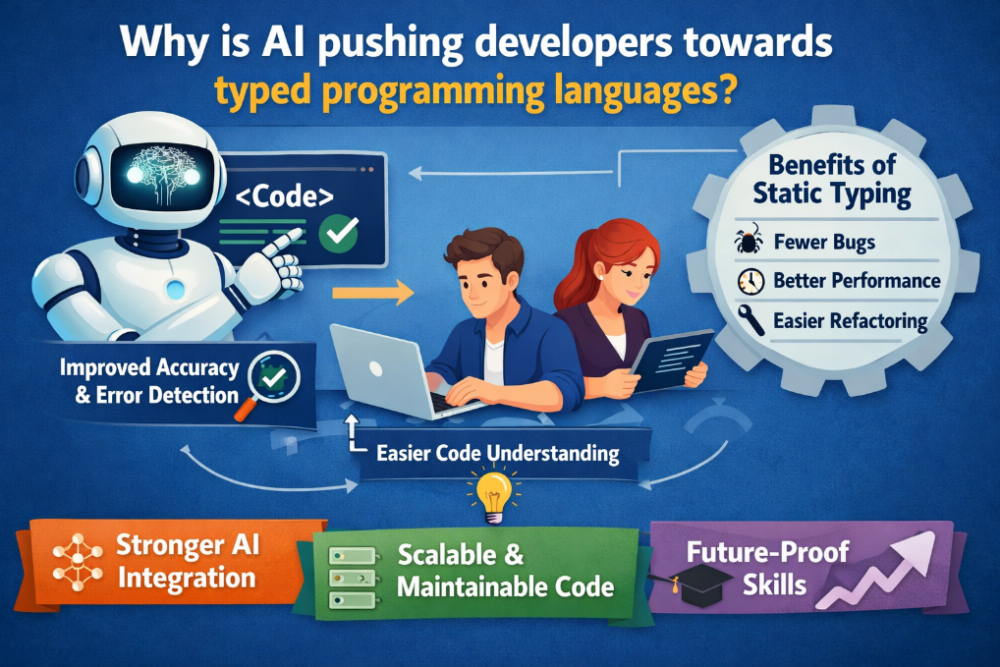
We are using Artificial Intelligence for various purposes, and it has become an important part of our daily lives. Over time, AI tools as well as techniques are changing, and developers are tracking these changes in the type of programming language they are looking to work with. Well, it is one of the most important trends and popular preferences for typed languages.
But why is AI driving this change? To understand this, we need to understand the key factors that are affecting the development of AI and how these factors intersect with the advantages of typed programming languages. If you are looking to understand this, then taking the Artificial Intelligence Online Course in India is a priority. So let’s begin discussing these reasons:
Reasons AI is Pushing Developers Towards Typed Languages:
There are some solid reasons that one needs to understand for getting proficiency in AI, and why it is pushing developers toward typed languages. People who have taken an AI Course in Gurgaon can learn this in detail from the professionals and work better in this way:
1. AI Needs a “Safety Net” for Code:
When you write each line of the code, you will have an idea that a variable called user_age is
Going to be a number. So when an AI assistant such as GitHub CoPilot generates a code line for you, it is like going through a stranger’s work.
In an untyped language, the AI might accidentally treat user_age as a piece of text (a “string”). The code might look perfect, but it will crash the moment you try to do math with it. In a typed language, the computer checks this immediately. If the AI suggests code that puts the wrong kind of data into a box, the editor flashes a red warning before you even run it.
2. Better Refactoring and Maintenance
One of the best ways to use AI is for “refactoring,” which is a modern word for cleaning up or changing old code. If you ask an AI to “change the way we handle addresses across the whole app” in a language without types, the AI might miss a few spots. This creates “silent bugs” that only appear weeks later. In a typed language, if the AI changes a data structure in one place, every other place that uses that data will instantly “break” in the editor.
3. The Rise of “Vibe Coding.”
There is a new trend called “vibe coding,” where developers describe what they want in plain English and let the AI build the entire thing. While this sounds easy, it only works if the “vibe” can be verified.
Typed languages provide the perfect structure for this. You can give the AI a set of types (a “schema”) and say, “Build a system that follows these rules.” The types act as the boundaries for the AI’s imagination.
4. A Shared Contract Between Human and Machine
Ultimately, types have become a “shared contract.” In the past, documentation was how humans communicated. Today, types are how humans and AI communicate.
When you define a type, you are telling the AI: “This is what I expect.” When the AI generates code, it uses those types to say: “This is what I’ve built.” This clear communication reduces the “hallucinations” (confident mistakes) that AI is known for.
Apart from this, if you are looking to master these modern programming skills, enrolling in an AI Course in Noida can provide you with the experience that is needed to build and manage the next generation of intelligent software.
Conclusion:
Currently, we are moving into the era where “writing code” is the complex part. But in the AI era, this definition has changed, and the complex part is validating and reviewing code. Well, typed languages can help make a job easier. It offers a clear structure, and they have turned A from a wild assistant that needs constant supervision into a reliable partner that follows the rules.