I’ve watched software development evolve in waves.
First, we automated builds. Then testing. Then deployments. Each step shaved off effort, but the core thinking—the planning, the decision-making, the trade-offs—stayed human.
Agentic AI feels different. Not louder. Not flashier. Just… deeper.
This is the first time many teams are seriously experimenting with systems that don’t just help developers, but act on intent. Systems that decide what to do next, execute it, and learn from the outcome. And once you see it working in the wild, it’s hard to unsee where this is going.
What “Agentic” Actually Means in Practice
Let’s clear something up early.
Agentic AI isn’t about replacing developers or handing over the keys to some runaway system. In practice, it’s about autonomous decision loops operating within guardrails.
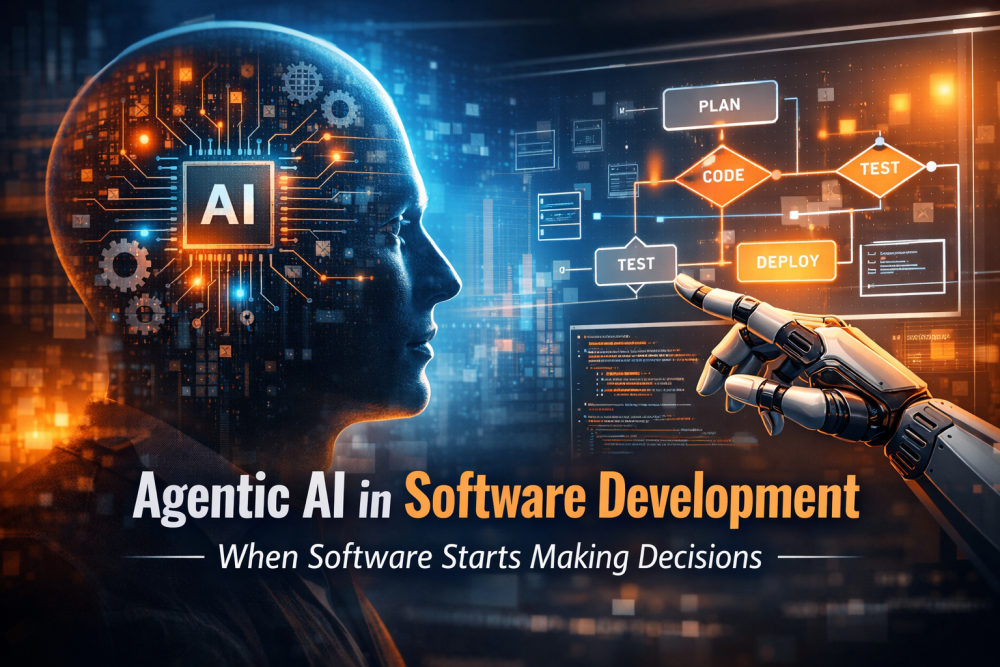
An agent doesn’t just wait for prompts. It:
- Understands a goal
- Breaks that goal into steps
- Chooses tools and actions
- Observes results
- Adjusts its next move
That’s a big shift from the assistive tools most teams are used to. Traditional AI helps you write code faster. Agentic AI helps decide what code should be written, when, and sometimes why.
Why This Is Showing Up Now (Not Five Years Ago)
Honestly? The idea isn’t new.
What’s new is that the surrounding ecosystem finally caught up.
A few things converged:
- Mature CI/CD pipelines with APIs everywhere
- Infrastructure that can be inspected and modified programmatically
- Better code understanding models
- Teams already comfortable with automation
Agentic AI works best in environments that are already structured. Clean repos, consistent pipelines, observable systems. Chaos still breaks it—just like it breaks humans.
Where Agentic AI Fits in the Software Lifecycle
This isn’t a single use case. It’s a pattern that shows up differently depending on the stage.
Planning and Task Decomposition
Instead of manually breaking epics into tickets, agents can analyze requirements, past delivery data, and system dependencies to propose task structures. Not perfect. But often good enough to unblock teams staring at a blank board.
Code Generation With Context
This is where people get excited—and cautious.
Agentic systems can generate code with awareness of:
- Existing architecture
- Shared libraries
- Style and patterns already in the repo
That context matters. Without it, you just get faster tech debt.
Testing That Actually Keeps Up
Most teams know testing lags behind development. Agents don’t get tired. They can:
- Generate tests as code evolves
- Detect coverage gaps
- Re-run scenarios after refactors
It’s not glamorous work. It’s just work that finally gets done.
DevOps Without Constant Babysitting
In mature setups, agentic AI can monitor pipelines, detect anomalies, and even trigger rollbacks or config changes. The key difference is intent. The system isn’t just reacting—it’s optimizing for uptime, cost, or stability.
The Quiet Productivity Shift Teams Don’t Notice at First
Here’s something I’ve seen repeatedly:
Teams don’t notice the biggest benefit right away.
It’s not speed. It’s cognitive relief.
Developers spend less time on:
- Repetitive decision-making
- Low-value troubleshooting
- Mechanical cleanup tasks
That mental space goes somewhere. Better design discussions. Cleaner abstractions. More thought before adding complexity. Over time, the quality curve bends upward.
What Agentic AI Still Gets Wrong (And Often Will)
Let’s be real. These systems are not wise.
They:
- Can over-optimize local decisions
- Miss business nuance
- Struggle with ambiguous human intent
- Occasionally make very confident mistakes
This is why fully autonomous development is still mostly a fantasy. The best results come from human-in-the-loop models where agents propose, act within limits, and escalate uncertainty instead of bulldozing through it.
Governance Isn’t Optional—It’s the Whole Game
If you’re experimenting with agentic AI without guardrails, you’re playing with fire.
Teams that succeed usually do a few things early:
- Restrict what agents can touch
- Log every decision and action
- Require approvals for high-risk changes
- Treat agents like junior engineers, not gods
The irony? The better the governance, the more freedom you can safely give the system.
How This Changes the Role of Developers
Developers don’t disappear. They shift.
Less time typing. More time:
- Reviewing decisions
- Designing systems
- Teaching agents through feedback
- Defining constraints and intent
In many ways, it feels closer to mentoring than coding. And that’s not a bad thing.
Adoption Advice From the Trenches
If you’re considering this, don’t start big.
Start where:
- Decisions are repetitive
- Mistakes are low-risk
- Feedback loops are fast
Build trust slowly. Expand scope deliberately. The teams that rush autonomy usually regret it. The ones that pace themselves tend to compound gains quietly.
The Bigger Picture
Agentic AI in software development isn’t a trend. It’s an architectural shift.
We’re moving from tools that respond to instructions to systems that operate on goals. That changes how software gets built, maintained, and evolved. Not overnight. But steadily. And once it’s embedded, there’s no going back.
FAQs
1. Is agentic AI the same as autonomous software development?
Not quite. Agentic AI focuses on autonomous decision-making within boundaries. Fully autonomous development implies end-to-end independence, which most teams aren’t ready for—and probably shouldn’t be.
2. Does agentic AI replace developers?
No. It changes what developers spend time on. Less execution, more oversight and design. The human role becomes more strategic, not obsolete.
3. What skills matter most when working with agentic systems?
System thinking, architecture awareness, and the ability to define clear intent. Prompting matters, but framing goals and constraints matters more.
4. Is this only useful for large enterprises?
Not necessarily. Smaller teams often benefit faster because their systems are simpler and feedback loops are tighter.
5. What are the biggest risks?
Poor governance, unclear boundaries, and over-trusting outputs. Most failures come from organizational mistakes, not model limitations.
6. How mature is the technology today?
Early, but usable. Think “power tools,” not “autopilot.” It works best when paired with experienced teams who understand its limits.
7. What’s the first practical use case to try?
Testing, CI/CD optimization, or code refactoring in non-critical services. These areas offer fast wins with manageable risk.