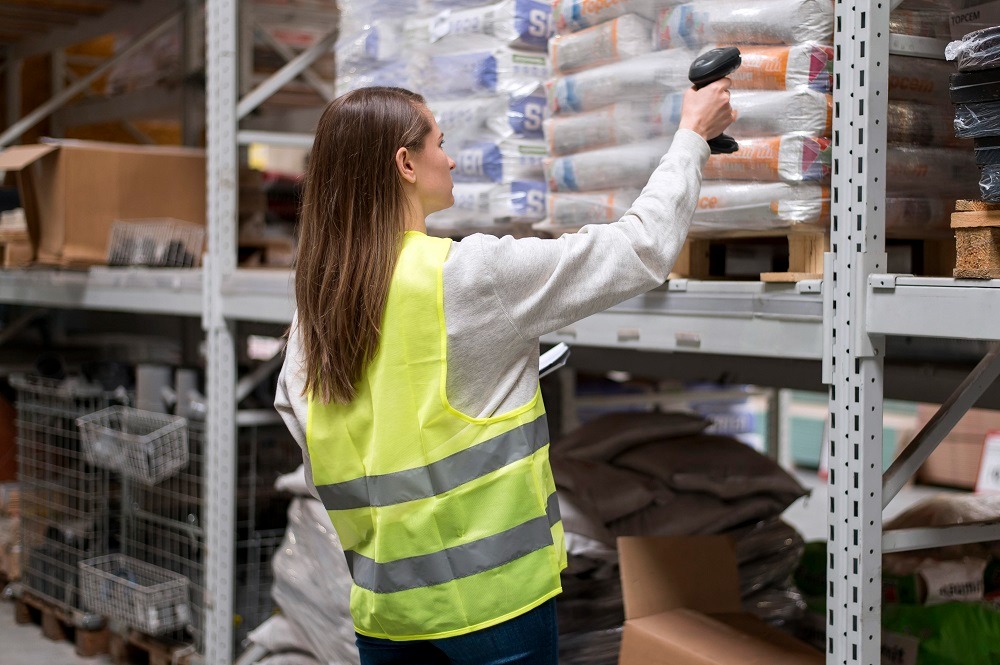
Order picking, as one of the functions of a warehouse, involves retrieving goods from their racking locations and is one of the most expensive and labour-intensive tasks. Approximately 55 percent of the resources of a warehouse are allocated to this single task. In the current, highly competitive world, manufacturing organizations are pressured to minimize operating expenses and maintain profit levels. In this context, order picking is a cost-effective process that contributes significantly to a company’s economic development.
It is therefore important to consider the holistic perspective and the factors that influence it, including warehouse racking layout, picking methods, warehouse racking or shelving systems, and rack zones.
To begin with, we will look at the kinds of order picking:
Piece Picking
It is the most widespread picking process, in which a single line of orders is picked at a time. Under this form of picking, no orders are scheduled, and they can be picked at any time of the day.
Advantages: It is easy to use and can be used for quick order fulfillment. It may be used to monitor the picker’s precision.
Cons: This is, however, not an efficient method because it entails a lot of travel time to pick.
Zone Picking
Under this approach, pickers are assigned designated areas in the warehouse and are expected to pick only the SKUs in those areas. Zone picking is best implemented when there are many orders, and they are received simultaneously.
Advantages: Since pickers have assigned zones, it does not cause as much interference with other pickers who are blocking aisles.
Cons: This approach does not work as well in warehouses where the customer orders are not as frequent or numerous.
Wave Picking
It is a mix of both zone and batch picking. As multiple pickers navigate the zones picking orders in the zone only, a “wave” of concurrent picking across the warehouse is formed. This form of picking would suit warehouses that have large numbers of SKUs.
Advantages: As the sorting and consolidation will be done later in the line, more similar-sized and shaped items can be picked in a single wave; thus, the process can be carried out faster.
Cons: To achieve all the downstream sorting into separated orders, some equipment (e.g. tilt-tray sorters) may be required; this can be costly depending on the size and nature of operations.
Batch Picking
Orders for the same location product are collected simultaneously in this system, reducing the number of repetitive trips to a specific location. It is applicable in scenarios where the concentration of SKUs is high in a wide area.
Pros: It is time-saving. In addition, it is cost-effective since most batch-picked products are typically moved on carts.
Cons: It can be used in large warehouses where it is possible to have carts overcrowding, as well as multiple pickers in areas where they are not supposed to be.
Automatic case picking (ACP) is common in different countries because of the space and labour costs. ACP is based on the use of robotics and other automated devices. To be clear in this article, we will be concerned with manual order picking.
How to Implement Conveyance Systems?
Store with the right storage systems.
The efficiency of the picking operations depends on the type of racking that is used to store goods in a warehouse. As an illustration, sluggish products are more suitable in bins on shelves, but the faster-moving SKUs would be moved in pallet racks.
Introduce Racks Slotting in the Warehouses
This is referred to as slotting, which is the system of storing like kinds of inventory in a specific storage racking space. It is possible to slot items based on their size, velocity, clubbing, seasonality, and so on, but surprisingly, the research results indicate that improper slotting in a typical warehouse could lead to a decrease in picking efficiency of up to 20%. Time-and-motion research has demonstrated that with the correctly slotted racks, it is possible to reduce errors and time spent on picking and boost stock visibility and access. By working hard, correct slotting may be ensured, and order-picking efficiency may be enhanced.
Optimize Material Storage at the Floor
It is a given fact that ground-level order picking is more productive than higher-level order picking. The problem is that warehouses do not have much space to store on the ground floor. This issue can be solved by placing fast-moving SKUs on the floor and low-rise as well as slow-moving ones on higher levels.
Invest in Training
It is accepted by the experts that effective warehouse activities, such as order picking, are a product of an excellent team effort. In this regard, frequent training and quality control of the operators of the warehouse are important activities. It will save vital time and money by training pickers to adopt the most appropriate and energy-efficient techniques of picking and packing orders. The financial savings can be refunded to the pickers as incentives for efficiency and speed. Such initiatives eventually can yield bountiful dividends.
In a Nutshell!
Order picking efficiency plays a vital role in the warehousing process because it defines the throughput, order fulfillment, and service levels. It is also a core element in the process of satisfying the customers and the continuous, unbroken operation of the logistics activities.
The speed and efficiency of the picking of orders has taken extreme importance, especially with the introduction of concepts like next-day and same-day deliveries becoming increasingly widespread among large-scale manufacturers and e-mailers. A single second might determine whether a scheduled delivery is on time or not.
Therefore, one of the most critical activities that warehouse operations should undertake is efficient and lean order picking, which must be reviewed and updated periodically to achieve optimal performance. To do it and simplify your activities, you may select pallet storage racks.