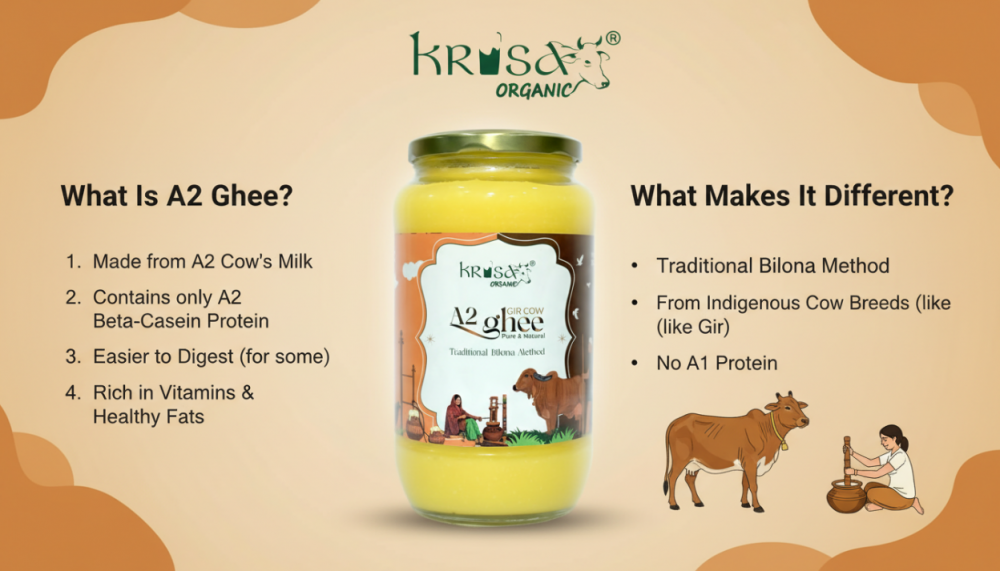
More and more families in India are switching from the standard A1 Ghee to A2 Ghee for their use in the kitchen. But what is A2 ghee and how does it compare with other types of ghee? Read on to learn about how both types of ghee are made, how they differ from one another, and why you should consider switching to A2 ghee.
What Is A2 Ghee?
A2 ghee is a clarified butter made from milk of native breeds of cows that possess A2 beta casein protein. Unlike many other dairy products, which have both A1 and A2 protein types, A2 milk from these cows will have just one type of protein – A2. Ghee made from this milk is considered to be pure A2 cow’s ghee. Cows from native cow breeds include (but are not limited to) Gir, Sahiwal, Tharparkar and Red Sindhi, and all produce A2 milk. These types of ghee use the Bilona method to create A2 ghee and is a traditional style for making A2 ghee. The Bilona Method will give you the very best a2 ghee in India.
Understanding the Difference Between A1 and A2 Milk
Milk has a protein mainly known as beta-casein protein. This beta-casein can be found in two forms specifically, that is A1 beta-casein and A2 beta-casein. So the Difference of A1 milk from A2 milk is the structure of the proteins. The A1 protein has a compound attached to it that is (BCM-7) known to cause inflammation in some people, thus making it harder for them to digest. Conversely, the A2 milk protein does not produce BCM-7, so the A2 ghee is easier to digest than the regular a1 ghee and typically does not cause as many problems in your stomach than regular ghee. So the a2 ghee is mostly preferred.
How A2 Ghee Is Made By The Traditional Bilona Method
Authentic A2 ghee is made by using the Bilona method, which has been used by Indians for many centuries as a tradition.
Step 1 Fresh milk from A2 cows is boiled.
Step 2 This boiled milk turns into curd naturally overnight.
Step 3 Then the curd is churned in a wooden bilona to obtain the butter from the curd.
Step 4 This butter is then carefully heated to create pure, golden coloured ghee.
This traditional method takes time and attention to detail in order to retain the following properties:
• Natural fragrance
• Nutritional value
• Authentic flavour
• Coarse texture of real ghee Industrial producers of ghee typically do not go through these processes at all; they process liquid cream directly into a final product, which will lower many of the nutrients available in ghee
A2 Ghee vs Regular Ghee & What are the Nutritional Benefits?
| Feature | A2 Ghee | Regular Ghee |
| Milk Source | Indigenous cows | Mixed or crossbred cows |
| Protein Type | A2 beta-casein | Often A1 or mixed |
| Preparation Method | Traditional Bilona | Industrial cream process |
| Digestibility | Easier for many people | May feel heavy for some |
| Aroma | Rich and natural | Mild |
| Texture | Grainy | Smooth |
| Nutritional Value | High due to traditional process | Depends on processing |
Because of these differences, A2 ghee is often considered as more natural and authentic.
Nutritional Value of A2 Ghee
A2 Ghee offers a number of essential nutrients to the body that will help with general health. These nutrient groups include:
• Naturally occurring healthy fatty acids
• A wide variety of vitamins and their respective derivatives i.e. Vitamin ‘A’, Vitamin ‘D’, Vitamin E, etc.
• Butyric Acid: A type of saturated fat found in a2 ghee that is believed to be having numerous digestive health benefits due to its anti-inflammatory effects present in it.
Health Benefits of A2 Ghee
Traditional Indian cooking has included A2 ghee for centuries and, when consumed in moderation, it has many health benefits.
The following are a few advantages of A2 ghee:
1) Improves Digestion
A2 ghee contains butyrate enzyme that may aid in digestion of rice in stomach. In addition, Ayurveda also recommends that A2 ghee helps to stimulate the digestive enzymes present in stomach.
2) Considerable Source of Healthy Fats
Healthy fats are beneficial for various body functions which includes:
• Supporting cognitive function,
• Regulating hormones and,
• Producing energy in the body.
A2 ghee also provides essential fats, and is considered a healthy fat.
3) High Smoke Point for Use in Cooking.
Ghee can be used in various ways to cook with high temperature settings because it has an extremely high smoke point.
Some cooking methods include:
• Sautéing,
• Frying, and,
• Traditional Indian dishes prepared with ghee.
While most oils that have been processed can’t take high heat settings, ghee is one oil that can take it.
4) Supporting Healthy Skin and Hair
Ghee is often used to support the overall health of both the skin and hair due to the added vitamins and nutrients that are available to support maintain the moisture (also known as hydration) in the skin, which are provided by consuming ghee:
• Healthy and glowing skin,
• Nourishing hair, and
• Maintaining moisture naturally (hydration) in your skin.
5) Supports Immune System
A2 Ghee is a highly nutritious food that contains various vitamins and other nutrients that helps to enhance the immune function properly.
NOTE :- Consume the A2 ghee from an established and trustworthy source only.
Reasonsfor the High Cost of A2 Ghee?
One of the main reasons why A2 Ghee is pricier compared to regular Ghee is due to its nutritional benefits for the body via; vitamins are a good way to boost our immune systems.
The price difference is due to a number of reasons:
1. Indigenous breeds of cows produce less milk than commercial breeds.
2. Traditional bilona (two vessels) method of making ghee takes longer.
3. Traditional farming practices are small-scale, natural and sustainable.
4. Quality standards are high.
For these reasons, authentic A2 ghee will be produced in small batches.
How to Identify Pure A2 Ghee
When purchasing A2 ghee either online or in-store, you will want to verify if the ghee is pure using the following characteristics of pure A2 ghee:
Characteristics of Pure A2 Ghee
– Has a natural golden yellow colour;
– Has a nutty aroma;
– Has a grainy texture when solidified;
– Is transparent (cannot see through it);
– Is made using traditional preparation methods like bilona; and
– Does not contain any artificial additives or low-priced products labelled A2 ghee.
How to Use A2 Ghee in Daily Diet
A2 ghee can be easily included in everyday meals.
Common ways to use it includes:
• Adding it to the dal and rice
• Applying on the rotis or parathas
• Cooking the vegetables
• Using it in traditional sweets
• Mixing a small amount in warm milk
Most of the nutrition experts recommend 1–2 teaspoons per day depending on the individual diet taken in a day.
Is A2 Ghee Suitable for Everyone?
Who Can Use A2 Ghee: The Very Short Answer Generally speaking, many individuals who consume A2 ghee can safely do so if they consume this product in moderation. Because when you create ghee by removing solids contained in milk which includes lactose, the amount of lactose left in your ghee will be at a very low amount, thus there won’t be any digestive issues with respect to A2 ghee. However, if someone has been diagnosed with a specific allergy to dairy products, they should consult a doctor or an allergist prior to eating A2 ghee.
Conclusion
A2 ghee in India has not only become an important part of people’s diets but has also become a significant source of traditional knowledge regarding Indian dietary customs and values. Not only did ghee made from native Indian cows using the traditional bilona method allow for a possible healthier alternative for regular ghee; it also provided some very essential nutrients crucial to overall health.
FAQs
Q. How A2 Ghee Is Made?
A: A2 Ghee is made from the Milk to clarified ghee from the cows of indigenous breeds known to produce A2 beta casein protein; these cows have a distinctive look about them.
Q. Why Is A2 Ghee Better For Me Than Regular Ghee?
A: There are many reasons why people prefer to use A2 Ghee over regular ghee. One main reason is that A2 ghee is easier to digest and has more vitamins than A1 ghee
Q. Which Types of Cows Produce A2 Milk?
A: There are many breeds of cows that produce A2 milk that are Gir cows (These are especially know in India.), Sahiwal, Tharparkar & Red Sindhi.
Q. Can I cook with A2 Ghee?
A: Yes A2 Ghee has a very high smoke point (692 degrees) making it an excellent product for frying food and other cooking purposes
Q. How much A2 Ghee can I eat on a daily basis?
A: An average, healthy adult can safely consume between 1-2 teaspoons of A2 Ghee each day.