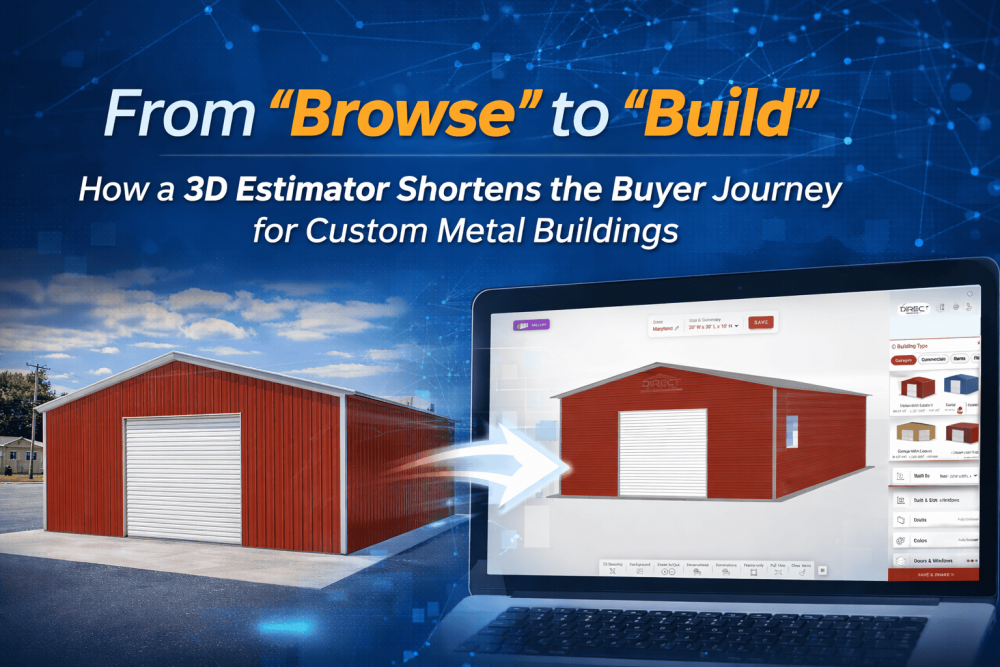
If you have ever priced a custom metal building the old way, you know how it usually goes. You start with inspiration photos, bounce between sizes, second-guess door placement, and then stop because you are not 100% sure what you need. A 3D estimator changes that. It turns “I’m just browsing” into “I’m ready to build” by helping you lock in a workable layout faster, with fewer surprises.
Whether you are a homeowner planning a shop, a farmer covering equipment, or a contractor trying to move a project from idea to approval, here is how a 3D estimator helps you make decisions with confidence.
Key highlights
- You can visualize size and layout instead of guessing from a spec sheet.
- You pick the big variables up front: width, length, height, roof style, and enclosure level.
- Doors and openings get planned early, which prevents expensive “redo the plan” moments later.
- You get a cleaner quote conversation because your configuration answers most of the first-round questions.
- It reduces back-and-forth with spouses, partners, or stakeholders because everyone can see the same model.
- It speeds up the path to engineer-ready options when wind and snow requirements apply.
- It makes upgrades feel practical because you can see what they solve, not just what they cost.
Why shopping for a metal building can feel slow (even when you are motivated)
Custom metal buildings are not like buying a grill or a generator. You are not choosing between two or three models. You are choosing a structure that has to fit:
- Your vehicles, equipment, or workflow
- The space you actually have on the property
- Door clearances and turning room
- Roof style preferences (and how your local weather behaves)
- Storage needs today and storage needs two years from now
- Code requirements that can change by location
That is a lot to juggle in your head. Most people hit the same sticking points:
1) “I can’t picture the size”
A 24×30 sounds big until you park a full-size truck and realize the workbench needs room too.
2) “I’m not sure where the doors should go”
A door that looks fine on paper can be awkward in real life if you need to back in a trailer, open wide truck doors, or move equipment through the space.
3) “I don’t want to pick the wrong roof style”
Roof style affects drainage, upkeep, and how the building handles wind uplift. It is not only a looks decision.
4) “I need to show someone else”
Homeowners need buy-in. Farmers need to coordinate with family or a foreman. Contractors need something clear to share with a customer.
A 3D estimator solves all of those problems with one simple change: it gives you a model you can react to.
What a 3D estimator actually does (and why it matters)
A 3D estimator is a visual configuration tool. You choose your building type and the major options, and the tool renders a 3D version as you go.
Instead of asking, “Is 12 feet tall enough?” you can see the proportions. Instead of thinking, “Should the roll-up door go on the end wall?” you can place it and visualize how you would drive in.
It is not magic. It does not replace good planning. But it cuts out a lot of uncertainty, which is what slows buyers down.
7 ways a 3D estimator shortens the buyer journey
1) It turns vague ideas into real dimensions
Most people start with a mental picture, not a measurement. A 3D estimator nudges you into decisions like:
- How wide does it need to be to park, walk, and work?
- How long does it need to be for storage and future add-ons?
- How tall does it need to be for doors, lifts, equipment, or loft storage?
Once those three numbers are chosen, you are no longer “shopping.” You are planning.
2) It helps you avoid the most common regret: sizing too tight
When people undersize a building, it is almost always for the same reason. They planned for the vehicle, but not the life around it.
A 3D view makes you think about:
- Walking space along the sides
- Where shelves, toolboxes, or a compressor will live
- Whether you want a work zone that is not boxed in by parked vehicles
If you are a contractor, it also helps you plan staging space, tool storage, and workflow. That matters just as much as square footage.
3) It makes door placement a decision, not a guess
Door and opening placement is where projects stall. You want convenience, clearance, and good traffic flow.
A 3D estimator makes it easier to test real-life questions:
- Do you need a door on the front, the side, or both?
- Will you pull straight in, or do you need space to swing in with a trailer?
- Do you want a walk-in door near the driveway or near the yard?
For farmers, this is huge. A building that is “big enough” can still be frustrating if access is wrong for equipment.
4) It helps you compare roof styles in a way people actually understand
Most buyers know roof styles matter, but they do not always know why. Seeing the roof shape in 3D helps connect the dots.
- Regular roof: a solid choice for many budgets and mild conditions
- A-frame roof: a classic look with improved shape for runoff
- Vertical roof: often preferred when you want better drainage and less debris build-up
If you live in a place with heavy rain, snow, or high wind, roof choice is more than preference. A 3D view helps you make a decision you will not second-guess.
5) It speeds up the quote process because your configuration answers the first 10 questions
Think about the typical first phone call. The team has to ask about size, roof type, doors, and enclosure level before they can give meaningful guidance.
When you start with a 3D configuration, you have already answered most of that. That usually means:
- A more accurate conversation on the first call
- Fewer “let me think about it and get back to you” loops
- Faster movement toward the right design for your needs
6) It creates an easy way to get input from other decision-makers
This is the quiet advantage most people do not expect.
A 3D model makes it easier to ask:
- “Is this layout what you had in mind?”
- “Do we want the entry here or on the other side?”
- “Do you think we should add another opening for airflow and access?”
Contractors: this is also useful with customers, because it prevents misunderstandings. Clear visuals reduce change requests later.
7) It helps you build toward engineer-ready options when your area requires it
Many areas have specific wind and snow requirements. Those requirements influence the design.
A 3D estimator does not replace engineering, but it does help you build a configuration that can be reviewed for code and site requirements. If your project needs engineer-certified options, starting from a clear configuration can make the next steps smoother.
A simple “10-minute” way to use a 3D estimator (without overthinking it)
If you want speed and clarity, use this order:
- Pick the building type (garage, barn, RV cover, commercial, etc.)
- Choose width and length based on what you park or store
- Choose height based on door clearance and headroom needs
- Pick roof style based on climate and upkeep preferences
- Decide enclosure level (open, partial, fully enclosed)
- Place the main door first, then add secondary openings
- Save the design and call with your configuration ready
The goal is not perfection on the first try. The goal is to get to a layout that works, fast.
Real-world examples: what “shorter buyer journey” looks like
Homeowner building a shop
Before: “I think I want a two-car garage with a workspace.”
After 3D estimator: “I want enough width for two vehicles plus a clear work bay, a large door up front, and a walk-in door on the side.”
That is a buyer who is ready for a real quote discussion.
Farmer covering tractors and attachments
Before: “I need something for equipment, but I don’t know how big.”
After 3D estimator: “I need this width so implements fit, this height for clearance, and openings placed so I can pull through.”
That is the difference between “maybe later” and “let’s get this moving.”
Contractor quoting for a customer
Before: Long calls trying to interpret what the customer means.
After 3D estimator: A shareable model that sets expectations on layout and options.
That is fewer revisions and faster approvals.
What to prepare before you design (quick checklist)
Have these ready and your build goes faster:
- A rough site sketch with usable space
- The largest vehicle or equipment dimensions
- The door clearance you want (not just what you can tolerate)
- Your top two priorities (storage, workspace, access, looks, etc.)
- Any local requirements you already know (permits, wind/snow considerations)
If you are not sure about permits, that is normal. The important part is to avoid guessing and get guidance for your location.
Frequently asked questions
Is a 3D estimator only for experts?
No. It is built for normal buyers. If you can shop online and drag options into place, you can use it.
Does a 3D estimator give me a final price?
It gives you a strong starting point for a quote conversation. Final pricing can vary by location, design requirements, and selected options.
What if I change my mind after I design it?
That is the point. You can test ideas quickly, adjust, and save what feels right.
Will my building be designed for my local wind and snow requirements?
If your area requires it, engineer-certified options are available. The safest path is to share your location and your configuration so the design can match local requirements.
I have a tight space. Can I still customize doors and layout?
Yes. In fact, tight spaces are where a 3D estimator helps the most because you can visualize access and clearance.
Wrap-up: the fastest way to move from idea to action
A 3D estimator shortens the buyer journey because it replaces uncertainty with a clear, shareable plan. You stop guessing. You stop bouncing between tabs. You make a few smart choices, see them instantly, and move forward with confidence.
If you are ready to turn browsing into a real plan, use Design Your Building and save your configuration. Then call (844) 340-8065 and we will help you dial it in.